
Losing Our Grip: Why Collective Sensemaking Matters More Than Ever
The Erosion of Collective Sensemaking
Every day, we scroll through conflicting headlines, overhear fragmented stories, and navigate conversations shaped by wildly different interpretations of the world. We’re not just disagreeing on solutions – we’re often not even seeing the same problems.
There’s a word for this breakdown: the erosion of collective sensemaking.
It’s not just a byproduct of misinformation. It’s a deeper fracture – a collapse in our shared ability to interpret, prioritize, and respond to what’s happening around us. While disinformation campaigns, media fragmentation, and political polarization certainly accelerate the issue, the root of the crisis is relational. We’re losing the civic habits, public spaces, and trusted relationships that once made collective interpretation possible.
What Is “Collective Sensemaking”
At its core, collective sensemaking is how communities build shared understanding. It’s the process through which people align on what’s real, what matters, and what actions are worth taking together.
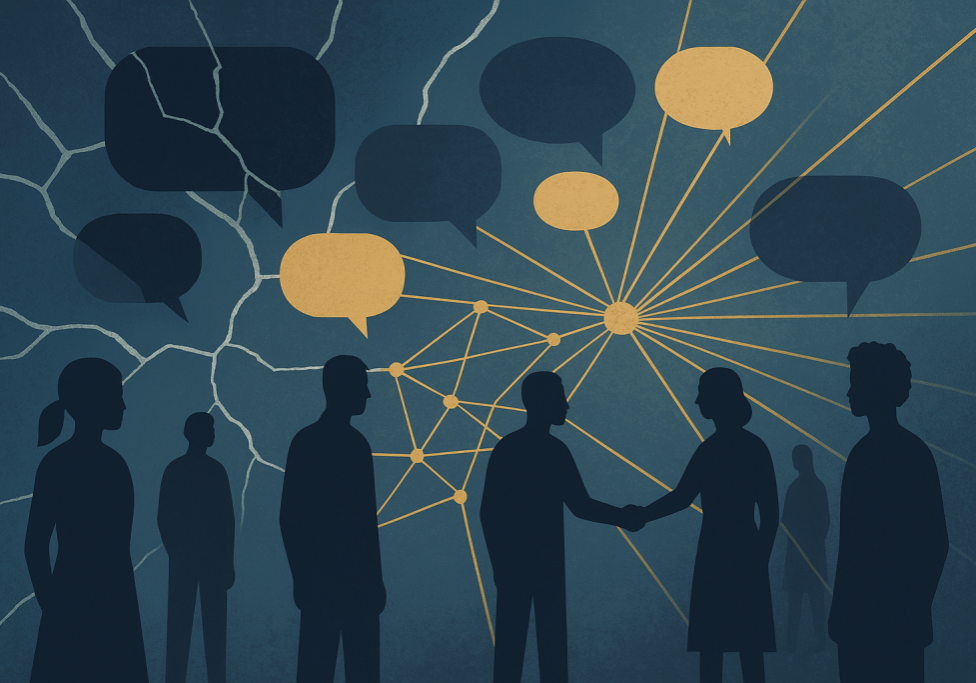
In previous generations, this happened through school boards, town halls, faith gatherings, neighborhood associations, and robust local journalism. These weren’t perfect spaces – but they were shared. They gave people a common starting point. They served as mirrors, reflecting both the fractures and the shared interests within a community.
Today, those mirrors are shattering.
Public meetings are sparsely attended or highly polarized. Local newsrooms are closing at alarming rates, while national outlets increasingly cater to partisan audiences, deepening ideological divides. Social media platforms, once celebrated for democratizing information, now optimize for engagement over accuracy – pushing users toward content that confirms their views and isolates them from dissenting voices. The infrastructure that enables collective meaning-making and with it Trust across lines of difference.
This Isn’t Just a Loss. It’s a Strategy.
There’s growing recognition that fragmentation isn’t just a side effect of digital life – it’s being weaponized. In some cases, disconnection is the strategy.
When people lose the ability to see and hear one another, it becomes easier for bad actors to distort, distract, and divide. That’s not theoretical – it’s happening now.
In the book Careless, journalist and former Facebook executive Sophie Zhang reveals how large platforms have not only enabled disinformation but actively avoided accountability for how their systems were exploited. In one of many examples, she recounts how coordinated manipulation in Myanmar – powered by anti-Muslim hate speech – helped fuel real-world violence and displacement, all while the platform failed to act on known abuse. The failure wasn’t just technical – it was systemic: harmful content spread unchecked due to weak moderation policies, minimal local oversight, and algorithms that amplified outrage. Despite internal warnings, little was done until it was too late.
Zhang’s work shows that the problem isn’t always just false information – it’s the collapse of the structures we once relied on to vet, contextualize, and respond. When community-wide sensemaking breaks down, even the truth struggles to gain traction.
So What’s the Solution?
There’s no single fix. Technology can help or harm. Better journalism, transparency laws, and media literacy all matter. But at the core, this is a relational problem. And it demands a relational solution. We are a social species and our fate is social.
At Netcentric Campaigns, we believe the antidote is clear: purpose-built, people powered networks.
Not just social media groups, a podcast hero, or mailing lists. Not coalitions that form and dissolve with every grant cycle. We mean deliberate, structured, values-based networks – systems of connection that prioritize trust, clarity, and coordinated action across differences.
We’ve been building and supporting those networks for more than two decades. And what we’re seeing now, across issue areas and geographic boundaries, is that when people have trusted relational infrastructure, they’re better equipped to resist manipulation and navigate complexity together.
What Makes a Network a Tool for Sensemaking?
Networks – when designed intentionally – aren’t just about communications. They’re about pattern recognition, mutual reflection, shifting power, and distributed strategy.
In a well-functioning network:
- People share data and stories across lines of geography, experience, and identity.
- Members surface weak signals that might otherwise be missed or suppressed.
- Individuals help one another interpret new information through trusted channels.
- Groups align around emerging insights, not just fixed positions.
Put simply: networks give people the ability to think together before they act together or individually to get big things done.
This Isn’t New Work. It’s Enduring Work.
At Netcentric Campaigns, we’ve spent decades helping people organize and build power through networks. Not just because networks are effective – but because they’re resilient. They’re built to hold complexity, foster trust, and evolve over time.
When done right, networks create the conditions for better thinking:
- They allow people to share what they’re seeing, test assumptions, and co-create meaning. They’re not just pipelines for information – they’re systems for understanding, grounded in real relationships and shared values.
That’s what makes them so vital now. In an environment flooded with noise, distraction, and division, networks offer clarity. They help groups stay coherent, grounded, and connected – even when everything around them is designed to pull them apart.
We’re continuing to invest in that work – not because it’s new, but because it’s more essential than ever.
As part of that ongoing commitment, we’ve begun exploring new initiatives that focus on civic infrastructure, narrative coherence, and digital resilience. We’re in the early stages of developing a new effort to investigate how networks can counter fragmentation at a broader scale. The work is still taking shape, and we look forward to sharing more as it evolves.
Let’s Start a Conversation
If the challenges described here resonate with you – if you’re navigating complexity, polarization, or fragmentation in your advocacy work – know that you’re not alone. These are systemic problems, but they’re not unsolvable.
At Netcentric Campaigns, we’ve spent decades helping organizations and movements build and strengthen the networks that make long-term change possible. Whether you’re facing a new organizing challenge or looking to reinforce an existing effort, we may be able to help you apply network strategies to increase your reach, clarity, and impact.
If this sounds relevant to your work, we’d love to connect. Let’s talk about what you’re seeing – and explore how our experience might support what you’re building.
Reach out to start a conversation.
Stay Connected
We also publish a monthly newsletter featuring network strategies, storytelling insights, and tools we’ve found useful across our projects. It’s designed for people working in advocacy, communications, and movement-building – anyone navigating how to create lasting change through connection and collaboration.
Subscribe to the newsletter to get ideas, resources, and stories from the field – delivered right to your inbox.