
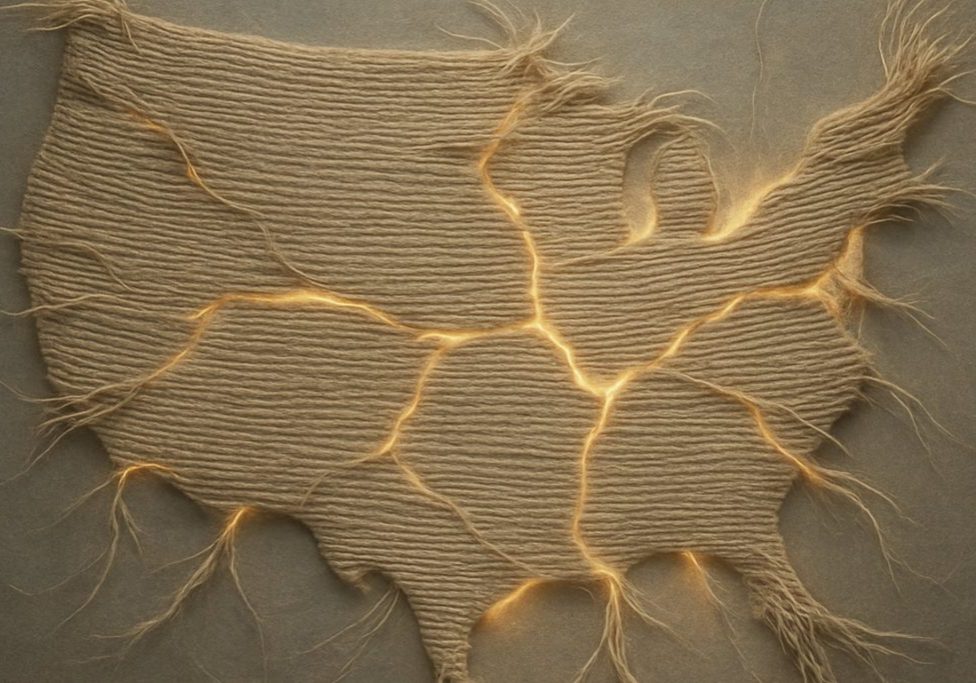
When the Civic Fabric Frays
Why disconnection is democracy’s quiet crisis – and what we’re starting to do about it
After decades of working with civic movements, public health coalitions, and grassroots campaigns, we’re starting to see something deeper at play – something bigger than any one cause. Across sectors and geographies, the very infrastructure that holds civic life together is deteriorating.
This isn’t just about politics or partisanship. It’s a broader social fracture. Disconnection is now a defining feature of American life—and it’s increasingly observable around the world. Trust in institutions is collapsing. People are losing faith—not just in systems, but in one another. And the tools we rely on to stay connected are often designed to pull us apart.
The erosion of social capital isn’t happening by accident. In many cases, it’s being actively engineered—for profit, for power, or for influence. These dynamics are playing out across global platforms, reshaping social cohesion in countries far beyond our own. As disinformation spreads faster than truth, and algorithmic systems prioritize outrage over understanding, the very conditions required for civic collaboration are being hollowed out.
Netcentric Campaigns has spent more than 25 years building and supporting networks – real networks that help people organize, collaborate, and build power together. Through all of that work, one insight has become increasingly clear: the health of any issue campaign is tied to the health of the broader civic network it relies on. And today, that larger system is in trouble.
We call this moment a connectivity crisis – a slow-motion breakdown of the ties that bind us. And we believe it deserves not only attention, but action.
Patterns We Can’t Ignore
From rural towns to urban coalitions, we’ve seen common threads emerge:
- Civic disengagement and participation fatigue
- Fragmentation of public discourse and deliberate disinformation
- Polarization and social siloing that discourage meaningful collaboration
- Institutions losing their ability to convene, listen, or adapt
- Organizers and advocates burning out amid isolation and dysfunction
Many of these trends are being documented in academic research and civil society reports. But too often, they’re treated as isolated challenges – symptoms to be managed rather than systems to be reimagined. At Netcentric Campaigns, we see them differently: as failures of civic infrastructure and early warning signs of deeper systemic breakdowns.
The problem is not just ideological division – it’s structural disconnection. The connective infrastructure that supports democratic life has been weakened. And we cannot expect institutions to function, movements to grow, or communities to thrive if the underlying networks of trust, communication, and collaboration are no longer intact.
How We Think – and Work – Through Networks
At Netcentric Campaigns, we’ve spent more than two decades working alongside organizers, advocates, and community members to build networks that support real collaboration. That work includes helping people connect across silos, identify shared goals, build common language, support distributed leadership, and foster mutual accountability. We don’t just design networks – we help them grow, adapt, and sustain momentum over time.
Our approach is shaped by a practical understanding of what makes a network functional – and what causes one to falter. We look for the conditions that allow trust to emerge and the patterns that lead to fragmentation or inertia. While others talk about trust, we work with the mechanisms that generate it. And while many assess civic life through political systems or formal institutions, we focus on the connective structures underneath – how people organize, communicate, and align.
This perspective doesn’t come from theory alone. It comes from experience – and it uniquely equips us to engage with the civic disconnection we’re seeing now. We recognize the scale of the challenge. But we also know how to begin: by mapping the network, listening carefully, and finding the places where new connection can take root. That’s the lens we’re bringing to this work – hands-on, systems-aware, and focused on building the capacity of people to act together in meaningful, durable ways.
A Starting Point
We’re launching a new, early-stage initiative grounded in a simple but urgent hypothesis: that the civic and social fabric of this country is under profound strain – and that addressing it will require new forms of organizing, new models of connection, and a renewed commitment to values-based networking at scale.
We’re not beginning this work with fixed talking points or a pre-scripted playbook. We’re starting the way we always do: by listening deeply, mapping the landscape, and looking closely at where relationships are strong, where gaps persist, and where people may be working in isolation. We want to better understand who’s operating in this space, what efforts are already underway, and what conditions might allow stronger, more resilient networks to take root.
This is not about launching a brand or staking a claim. It’s about convening with care – building connective tissue between people and institutions who may not yet see themselves as part of the same challenge, or the same opportunity. This is systems work. Cultural work. Long-term work. And it begins here.
What Comes Next
This isn’t a campaign with instant answers or tidy outcomes. It’s a starting point – a way to name a challenge we’ve encountered across years of network building, and to begin engaging with it more directly. The fragmentation we’re seeing is real, and the urgency is growing. But addressing it won’t come from quick fixes. It will require patience, intention, and the scaffolding of connections that allow real change to take root and endure.
We’ll be working in the open: publishing what we learn, experimenting with formats, and building relationships with the individuals and organizations already wrestling with similar challenges. Some of this will take the form of blog posts and essays. Some may become interviews, assessments, or workshops. The structure will emerge as we go.
This isn’t just about Netcentric Campaigns. It’s about building a bigger table – one that welcomes anyone working to restore the connective infrastructure of civic life.
Get Involved
If you’re working on trust, resilience, civic engagement, or the health of public discourse – this is an invitation. If you’ve felt the fragmentation in your community, your movement, or your networks – we want to talk. And if the framing here resonates with something you’ve been sensing, even if you haven’t found the words for it yet – reach out.
We’re building in the open, and we’re looking for people who see what we see. In a moment defined by disconnection, one of the most powerful things we can do is help people reconnect – with purpose, with strategy, and with care.
If you’re exploring these questions from any angle – as an organizer, a civic technologist, a funder, a public-sector leader, or a researcher – we’d love to be in conversation.
Let’s find out what’s possible, together.