
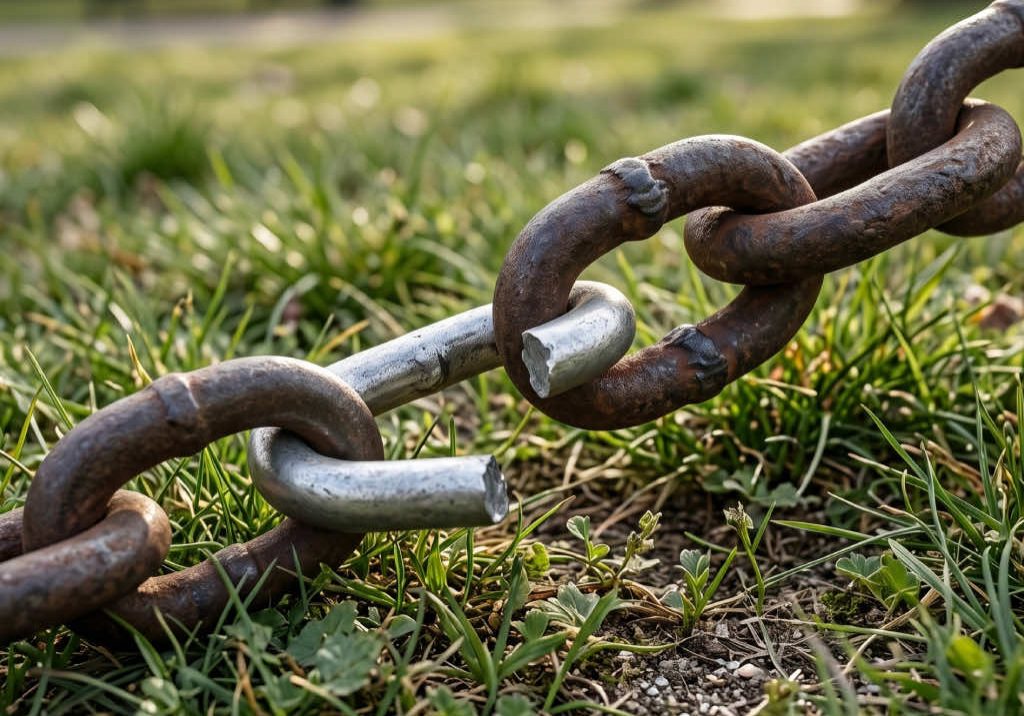
Progress Moves at the Speed of the Weakest Link
I recently watched a presentation by Stanford economist Chad Jones about AI, economic growth, and why even transformative technologies often take longer than expected to change the world.
The context was artificial intelligence, but one idea stayed with me for reasons that had very little to do with AI. Jones talked about weak links. A chain can have many strong parts, but the strength of the whole chain is still limited by the weakest one. You can make several links dramatically better, even radically better, but if one essential link remains fragile, the whole system still moves slowly.
That clicked with something we have seen for years in public systems work.
When people talk about water, sanitation, and hygiene, the conversation often starts with visible infrastructure. Boreholes. Pipes. Pumps. Toilets. Treatment systems. Trucks. Facilities. Budgets. These are essential. In many places, they are the most urgent need. If a community does not have access to safe water, then the weakest link may very well be capital, construction, and delivery.
But infrastructure is not the whole chain.
A WASH system also depends on maintenance, household practices, customer support, public understanding, complaint response, local trust, shared expectations, and the relationships among the people responsible for keeping the system working. These are less visible than a new pump or a new facility, but they shape whether the investment becomes durable public value.
That is where the weak-link framing becomes useful. It helps explain why progress can feel so slow, even when serious people are working hard and real investments are being made.
You can have a stronger water supply and still have poor health outcomes if people do not know how to safely store water after it reaches the household. You can have a complaint mechanism that technically exists, but still have unresolved problems if people do not trust that anyone will respond. You can build a system that looks impressive on paper, but if maintenance responsibilities are unclear, the system starts to weaken the moment something breaks.
The visible link improved. The chain did not.
This is one of the reasons WASHDesk has been such an important project for us. It is easy to describe WASHDesk as a communications platform, a customer service function, or a feedback tool. It is all of those things, but that description can undersell the deeper work. WASHDesk is a model Netcentric Campaigns helped create to strengthen the connective human infrastructure around WASH systems so they can listen, respond, adapt, and keep working after the hardware is in place. We built it this way because the missing link was not simply better messaging or more data. It was a practical support system that could connect people’s everyday questions, complaints, experiences, and trust back into the operation of the system itself.
That kind of work is rarely glamorous. It does not photograph as well as a ribbon cutting. It does not always fit neatly into a donor dashboard organized around assets built or facilities improved. But it may determine whether those assets keep producing value. That is why this kind of customer support and network infrastructure deserves investment alongside physical infrastructure, not after it, and not only when something starts to fail.
One of the more striking things we have been wrestling with is how little the WASH sector seems to have formalized customer service as a serious field of practice. There are best practices for finding water, treating water, moving water, and building facilities. There is technical knowledge at every stage of physical delivery. But once the system reaches people, the field gets thinner.
What happens when users have a question? What happens when a pump fails? What happens when people misunderstand what they are paying for? What happens when community members have observations that could help operators fix a problem earlier? What happens when people have lost trust because the last system failed?
In many sectors, those questions would be understood as central to the business. Banks, telecoms, utilities, and consumer service companies all know that customer support is not a side activity. It is part of how the system maintains trust, teaches people how to use services, hears what is going wrong, and protects long-term participation.
WASH systems need that same seriousness. If the sector wants stronger long-term outcomes, then customer support, feedback, trust-building, and local communication cannot be treated as extras. They need to be funded as part of the system’s operating capacity.
This is not an argument against infrastructure. It is an argument against pretending infrastructure can carry the whole burden of change by itself. The weak link changes depending on the context. In one community, the urgent link may be the capital required to build the first borehole. In another, it may be the maintenance system. In another, it may be household WASH literacy. In another, it may be customer service. In another, it may be a lack of trust between residents, providers, and local government.
The question is not which link matters most in the abstract. The question is: what is the weakest link now?
That question is also why networks matter.
In complex systems, people often assume coordination will happen because it needs to happen. They assume information will move because it is important. They assume community leaders, service providers, officials, technicians, health workers, journalists, and residents will somehow stay aligned because the goal is shared.
But human networks do not become strong by assumption.
The human side of a system becomes fragile when the conditions for coordination are left to chance. People may care about the same outcome, but if they do not trust one another, understand the same terms, know where to share information, or have clear ways to act on what they are hearing, the system starts to lose signal. Problems surface late. Responsibility gets blurry. Local knowledge stays local instead of becoming useful intelligence for the whole system. Over time, the network of people that should help the system adapt becomes one of the places where the system slows down.
It does not have to stay that way. With care, rigor, and the right architecture, the network of people behind a system can become one of its strongest links. It can help identify problems earlier, move information across boundaries, clarify confusion before it becomes distrust, and connect local experience to operational response. It can also shift how communities understand their role, not just as recipients of services, but as participants in keeping the system healthy.
That is the work Netcentric Campaigns has spent decades developing. We build networks with attention to the relationships, routines, roles, and feedback mechanisms that allow people to coordinate around wicked, complex problems. In WASHDesk, that means supporting the connective layer around water and sanitation systems: the people who hear complaints, explain services, answer questions, identify patterns, elevate issues, and keep local experience visible to the people who can act on it.
A strong network does not magically solve every technical or financial problem. It does something more practical. It helps the system notice where the next weak link is forming.
That is a different way to think about progress. Instead of asking only whether a project launched, a facility opened, or a system expanded, we also have to ask whether the system is becoming more capable of learning. Can people raise concerns? Can those concerns be heard? Can the right people respond? Can the response be trusted? Can the lessons move across the network so the same problem does not repeat everywhere?
Those are not soft questions. They are performance questions.
Jones’ weak-link framing gives us a relatable and useful way to name a pattern that shows up often in WASH work: the path to faster progress is not always found by pushing harder on the strongest or most visible part of the system. Sometimes it comes from noticing the link we have been underbuilding because it looked too ordinary, too relational, or too difficult to count.
Customer service. Trust. Local leadership. Communication. Feedback. Household practice. Maintenance. Shared responsibility.
These are not peripheral to WASH progress. They are part of the chain.
And if we want the whole system to move faster, we have to keep asking where the chain is weakest, then build the network capacity to strengthen it.
Where Do We Go From Here?
Are you seeing these kinds of weak links in your own work? Whether you are working in WASH, public health, climate, democracy, or another complex system, Netcentric Campaigns can help you examine where connective capacity may be slowing progress and share lessons from our broader network-building work. Let’s explore how stronger networks can help your project move from isolated effort to durable systems change.