
From Muddy Roads to Civic Renewal: The Power of a Common Story
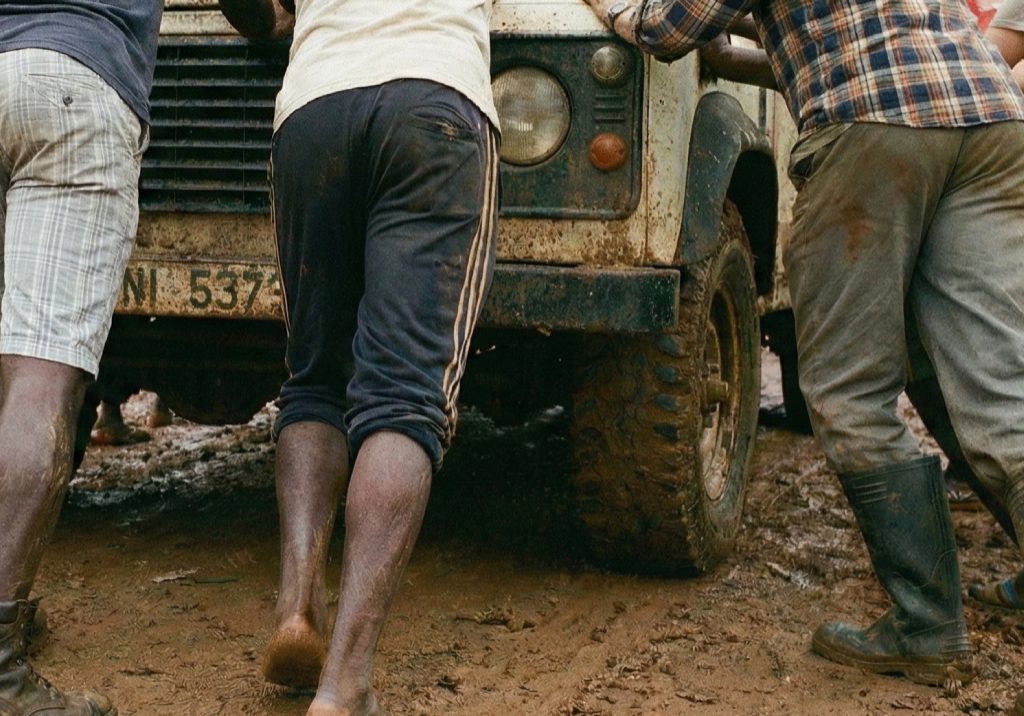
On a recent trip to Ghana, two Netcentric Campaigns staffers, and several local colleagues found themselves together in a truck sinking deeper into mud on a rural road. Tires spinning, shoes off, they struggled with some new local friends to push, heave, and improvise their way back onto solid ground. It could have been simply an inconvenience. Instead, it became something else entirely. It became a shared story.
In the days that followed, many conversations unrolled the same way. They would say, “We got stuck,” and instantly people lit up. Everyone had their own version of that moment. A time they had pushed a truck, or been stranded in the rain, or wrestled with a stubborn patch of red clay. Laughter followed. Recognition followed. In minutes, the room warmed. The story acted like a bridge. A decoder. A shortcut to trust.
The experience reminded us of a truth that is easy to overlook in an era defined by fragmentation and hyper-individualized information streams. People find one another through stories long before they align around strategies.
A common story is not a communication tactic. It is network infrastructure. And truth be told, sometimes these stories have nothing to do with the strategies or the topic at hand.
Right now, in a civic environment polluted by disconnection, our common stories may be one of the most powerful tools we have.
Why Stories Matter for Networks
In the Seven Elements of Effective Networks, we talk about social ties, common language, clear vision, and feedback loops. These often show up as discrete ideas, but in practice they are deeply interdependent. A shared story is one of the few things that can carry all four elements at once.
A good story tells you how someone might act. It shows:
- How someone positions themselves in the story.
- How they position others, including who they celebrate and who they listen to.
- The kinds of challenges they believe matter and how they face them.
A story that has nothing to do with work can still have an enormous impact on trust and relationships. These signals shape how people understand one another long before any discussion of goals or strategies begins.
The Ghana moment worked precisely because it was emotionally accessible, non-hierarchical, and human-scale. It offered an immediate sense of “we,” not through strategy documents or organizational charts, but through a shared muddy road and a feeling everyone recognized.
This is how networks strengthen. Not through data alone. Not through urgency alone. Through shared narratives that create the conditions for trust, collaboration, and generosity.
The Crisis of Common Story in a Polluted Civic Environment
Over the past few months, Netcentric Campaigns has been developing a concept we call civic pollution. It describes the accumulation of social externalities that erode trust, collapse shared reality, and weaken our civic immune system. Fragmentation thrives when people no longer recognize themselves in one another’s experiences. When the stories we rely on to make sense of the world diverge so radically that they no longer overlap, cooperation becomes nearly impossible.
In previous eras of institutional reform, Americans disagreed fiercely, but we disagreed inside shared narrative frames. There was a common vocabulary for public problems. There were cross-cutting relationships and shared spaces where people could make meaning together.
Today that civic glue has thinned. Information is personalized. Technological hardware rewards isolation. Our systems of commerce demand instant gratification. Media platforms reward outrage. Communities splinter into micro-realities. In the absence of a common story, civic pollution accelerates. Misinformation spreads. Distrust calcifies. Collaboration becomes brittle. Even successful campaigns struggle to scale.
The consequence is not just polarization. It is paralysis.
A network without common stories eventually becomes a set of disconnected efforts, each pushing alone.
A Common Story as Civic Infrastructure
A shared story is not about forcing consensus. It is not about smoothing over differences. It is about creating a relational container strong enough to hold difference without shattering it.
In our fieldwork, we consistently see networks succeed because they began with common experiences that had nothing to do with strategy or outcomes. Those early stories build trust, familiarity, and a sense of relationship long before anyone can clearly articulate why the work matters together rather than apart.
In those moments, the network’s capacity to act together weakens. An otherwise compelling public health campaign may falter in the face of competing storylines. Climate organizers may lose momentum, not because the science or narrative is unclear, but because communities do not share a common account of what is happening to them.
We have seen this pattern repeatedly. In these cases, the missing ingredient was not talent, funding, or strategy.
It was story.
A story is what lets people locate themselves in a movement. It is what turns strangers into collaborators. It is what helps a network metabolize conflict instead of splintering under it.
At scale, a shared story is civic infrastructure. It is as crucial as data systems. It is as consequential as formal governance. It is far more foundational than any single campaign.
What Network Leaders Can Do Right Now
The good news is that a common story is not something we must wait for. It is something we can build and cultivate.
Here are practical ways network leaders can cultivate shared narrative:
- Start with human-scale stories, not abstractions.
Just as the Ghana mud story broke the ice, local, grounded narratives create openings for connection far more reliably than policy frames. - Name the shared struggle.
People align more easily around a common problem than a common solution. In civic pollution work, this means naming the forces that fragment us and inviting people into the project of repair. - Build vocabulary intentionally.
Common language is not jargon. It is the set of words that help people understand their work as part of something larger. It can be as simple as shared metaphors, recurring touchstones, or phrases that reinforce belonging. - Treat story as collective property.
Networks thrive when stories are not owned by leaders but shaped by participants. Build mechanisms for people to add, adapt, and retell the story. - Use story to bridge audiences.
If leaders, supporters, and low-engagement activists each occupy different narrative worlds, a common story can create the connective tissue needed for alignment.
Where We Begin
The Ghana moment is a reminder of something profound. People want to connect. They want to laugh together, recognize one another, and build something in common. Even in a fragmented world, the impulse toward shared meaning has not disappeared. It has only become harder to grab.
Civic pollution thrives where common stories disappear. Networks thrive where common stories take root.
If we want movements capable of meeting the challenges ahead such as climate, democracy, public health, and justice, we must invest not only in strategy and capacity but in narrative coherence. We must rebuild the civic glue that allows institutions, coalitions, and communities to grow.
And we can begin anywhere. Even on a muddy road, far from home, with nothing but a stuck truck and a circle of people trying to push together.
If this work resonates with what you are seeing in your own community or movement, we would love to share a conversation. Reach out to connect, to share what you are building, or to explore ways to strengthen your network’s story. You can also subscribe to the Netcentric Campaigns newsletter to receive practical tools, insights, and updates on our civic pollution work. Together we can repair what has been fractured and build the shared story our democracy needs.