
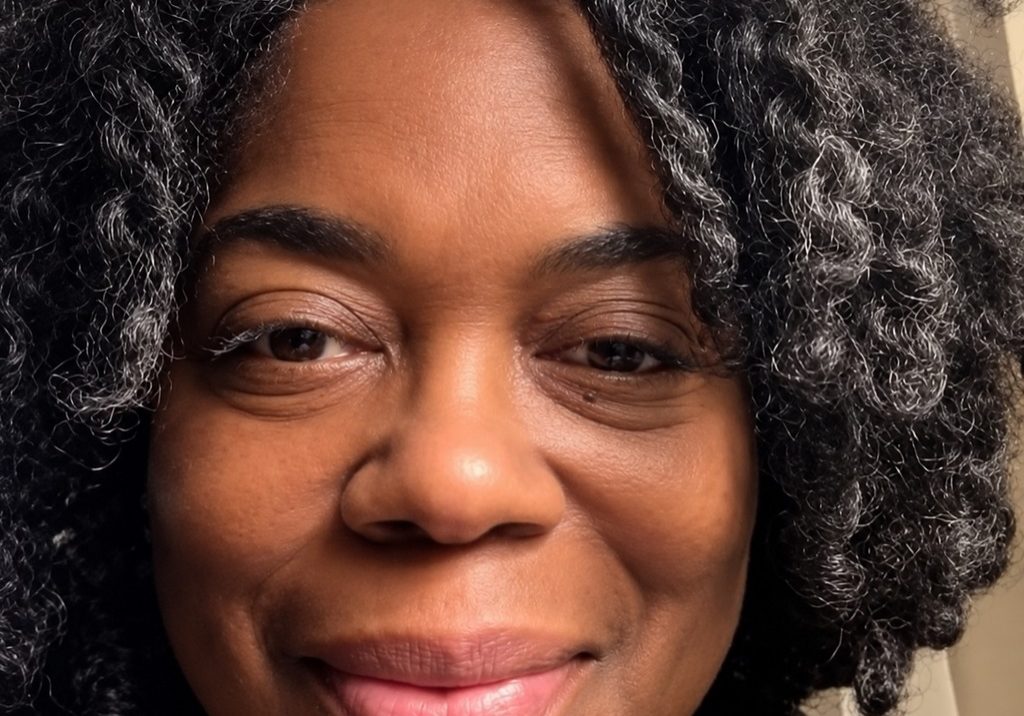
Brenda Jones on Public Service, Trust, and What Comes Next
The people who serve on the Netcentric Campaigns board come to network building from different directions. That range of experience matters. Networks depend on people seeing problems from different angles, and the board is no exception.
As part of an ongoing series of conversations with board members, we sat down with Brenda Jones to talk about the experiences that shape how she sees this work. Brenda has spent most of her career in public service and mission-driven communications. She worked nearly 16 years with the late Congressman John Lewis as his primary speechwriter and lead communications strategist, and later served as a Senior Presidential Speechwriter for President Joe Biden.
Her path into that work was not direct. She once imagined a career in music. She did not immediately see herself as a writer. And while communications is the craft for which she is best known, our conversation kept returning to something underneath the words: whether people trust one another, whether they are working toward the same ends, and whether they are organized well enough to turn ideas into action.
Those questions feel especially relevant to the work of Netcentric Campaigns and to the civic environment in which networks operate today.
A Public Service Career That Started Close to Home
Brenda was born and raised in Washington, D.C., where politics, government, nonprofits, and civic life were simply part of the landscape. She grew up with the sense that participating in society and making a constructive contribution was something people did. She also came of age during a period when people were pushing institutions to respond to new demands for rights, opportunity, and dignity.
That orientation stayed with her.
“I’ve always had an interest in how ideas can serve humanity,” she said.
With only a brief early exception, she has spent her professional life in government or nonprofit organizations; places where ideas could be tested against public life and, at times, translated into changes that affected millions of people.
Her path into communications took longer to come into focus. As a teenager she wanted to be a composer and producer. Writing was something she knew she could do well, but it was not where she first imagined putting her energy. Over time she recognized that writing was the place where her abilities fit.
Music never fully left the picture. Brenda believes the ear she developed through music still shapes how she writes. Yet she also sees a meaningful difference between the two forms. Music can reach people at an enormous emotional scale, powerful but sometimes difficult to direct. Writing gave her a way to work with that same creative impulse more precisely.
“Music goes out, but you don’t know exactly what it’s doing,” she said. “Whereas writing, you can make an argument that people can hear, process, and react to.”
She describes writing as giving communication a “vector.” A writer makes hundreds of small decisions about words, meaning, rhythm, and emphasis, but those decisions ultimately serve the work of moving an idea somewhere. That understanding became central to her political work. It also gave her a clear view of what communication can accomplish. And what it cannot.
Sometimes the Problem Is Not Communication
One of the most revealing parts of our conversation grew out of Brenda’s experience watching political leaders try to work across conflict.
She recalled a program designed to help members of Congress and their staff improve their negotiation skills. The premise was familiar: congressional dysfunction might be addressed by teaching people how to negotiate more effectively.
Brenda was skeptical.
“We negotiate all the time about everything,” she recalled thinking. “Our ability to negotiate is not the problem. Our problem is trust.”
That distinction is easy to miss. A breakdown between people can look like a communications problem from the outside. Better language, a facilitated conversation, a new message, or more practice finding common ground can help. But none of those address a situation in which people believe agreements will not be honored, or in which the parties are pursuing fundamentally different outcomes.
Negotiation works when there is enough of a shared objective to negotiate around. People can disagree sharply about the route and still bargain over how to get there. It becomes far more difficult when the destination itself is contested.
Working for two leaders she describes as men of great integrity during difficult periods in American history shaped another conviction: in hard times you have to know where you stand and be prepared to accept the consequences. “There are some things worth dying for,” she said. “There are some things that a career is worth sacrificing for.” Too often, she worries, people become so focused on their individual security that they are unwilling to take the risks necessary to protect larger principles.
Brenda’s diagnosis of the current civic environment begins here. Some of the conflict we see is routinely misdiagnosed because people respond to the surface disagreement without doing enough to understand what is driving it.
“You need to research,” she said. “You need to understand what is going on in a precise way.”
History matters. Current movements do not appear from nowhere. Understanding where an idea came from, what its proponents are trying to achieve, and how they are organizing around it changes the strategy for responding.
There is a clear network lesson in that observation. At Netcentric Campaigns we spend considerable time thinking about communication among people in networks, yet communication is only one part of the infrastructure. Strong networks also depend on social ties, common language, a clear vision, feedback mechanisms, leadership, and shared resources. If the relationships underneath the communication are weak, simply increasing the volume of messages is unlikely to repair them. Trust has to be built and maintained as part of the work itself.
From Communication to Collective Agency
Brenda’s connection to Netcentric Campaigns came through a friend who was working with Marty Kearns and the organization at the time and encouraged her to get involved.
At first she felt slightly outside the usual world of network practitioners. Her career had been built around communications and public affairs rather than network theory. But the underlying idea made immediate sense to her.
What she brought was less a missing skill than a different vantage point: deep experience translating complex public work into language that travels, holds attention, and helps people see their own role in it. That kind of outward storytelling is distinct from the communication networks need internally to function, and it remains one of the quieter but important edges of the work.
“I certainly do understand how networks can create change,” she said. “I like the whole concept of the empowerment of people through their ability to take action within a network to make something happen. I think that’s fantastic. Very democratic.”
That emphasis on agency feels especially important now. Brenda is concerned about the pressure being placed on American institutions and about how organized some anti-democratic efforts have become. At one point she compared the moment to a forest fire; destructive and unsettling, yet also capable of creating space in which something different may eventually grow. What emerges is not predetermined. It depends in part on whether people are willing to participate in shaping it.
She is not arguing for people to wait and see. A repeated point in our conversation was that those who care about democratic institutions need to become more strategic and better organized. She had been reading that morning about political organizations already planning several years beyond the next election. Her concern was that too many people remain focused almost entirely on the immediate fight.
“We have got to become much more strategic about how we engage the ideas that we want to see happen,” she said.
For Brenda that action remains firmly rooted in democratic participation: vote, organize, use legislative tools, elect people who represent your goals, be clear about what you expect from them, and hold them accountable. Networks expand the capacity to do those things because people do not have to act alone. They can share information, find others working toward related goals, identify where leadership is emerging, and move support toward opportunities as they develop.
Brenda has spent much of her career thinking about how ideas move. Network building adds another question: what becomes possible when the people receiving those ideas can also find one another and act together?
Knowing What Was, and Deciding What Comes Next
Near the end of our conversation we asked Brenda what she would say to younger people who look at the current environment and feel overwhelmed by it.
Her answer did not gloss over the difficulty. For people who have spent years working inside public institutions, this period can feel particularly hard.
“We are seeing things that we built, even participated in building, being destroyed,” she said, then quickly qualified: potentially destroyed. We do not yet know the outcome.
That uncertainty matters. Brenda sees a different vantage point for younger generations. They may have both the opportunity and the responsibility to rethink some of the institutions and public goods they inherit.
“One of the good things about destruction is it makes room for the new,” she said.
Her advice is to prepare for that responsibility by learning. Understand the institutions that exist and the history behind them. Understand what worked, what failed, and why. Then spend serious time thinking about what should come next.
“Unless we think it’s the end of the world, then there is absolutely a future,” Brenda said. “What young people have to do is determine what they want that future to be, what they want it to mean, and to think strategically about how they can get there.”
There is plenty in the current moment to make people pessimistic. Brenda readily admits to feeling some of that herself. But pessimism does not settle the question of what happens next. People do.
For Netcentric Campaigns, that is a familiar place to land. The work begins with the conviction that people who are connected to one another, who understand what they are trying to accomplish, and who have the trust and capacity to act together can change the systems around them.
Brenda came to that idea through a career spent working with words, politics, leadership, and public institutions. Her contribution to the board brings that experience into the room, along with a useful reminder for anyone building networks today: before we worry about saying the right thing, we should make sure we understand the problem, the people involved, and the future we are actually trying to build together.