
What Blue Zones Teach Us About Civic Capacity
Public health conversations usually begin in familiar territory: hospitals, insurance systems, medical technologies, and treatment access. These are the visible components of the health system, and understandably they get the greatest attention. When outcomes decline, the instinct is to expand care, improve diagnostics, and increase capacity to treat illness.
Those investments matter. But they are responses to conditions that often take shape long before anyone enters a clinic.
Over the past several decades, researchers studying longevity have identified regions of the world where people live significantly longer than expected. These regions, now widely referred to as Blue Zones, were first identified by researcher Dan Buettner and colleagues studying communities such as Okinawa in Japan, Sardinia in Italy, and Nicoya in Costa Rica. Their work, popularized through research publications and the documentary Live to 100: Secrets of the Blue Zones, highlights places where people routinely live into their 90s and 100s while maintaining strong physical, emotional, and social well-being.
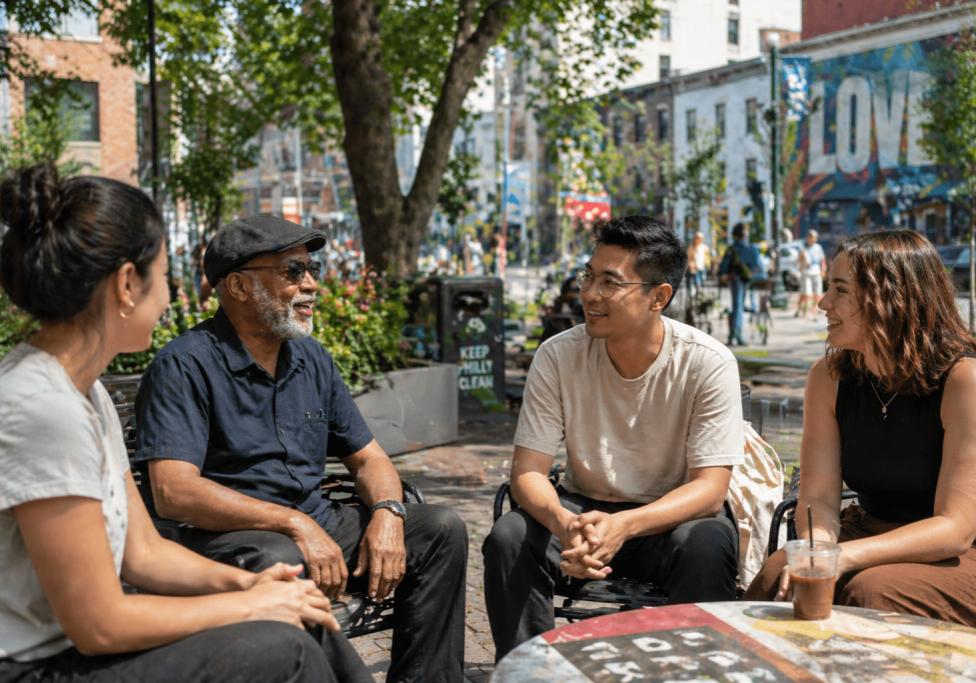
The most consistent drivers of longevity were not clinical innovations or isolated lifestyle choices, but the structure of daily social life. People were embedded in networks of relationships. They participated in shared routines. They remained connected across generations. Belonging was not occasional. It was routine.
That observation shifts the conversation. What Blue Zones reveal is not simply a collection of healthy behaviors. They reveal functioning social infrastructure.
What Blue Zones Actually Reveal
Much of the public conversation about Blue Zones focuses on surface-level descriptions: plant-based diets, regular walking, strong family ties, and purposeful living. These details are accurate, but they are often interpreted as individual choices rather than system-level patterns.
Walking in Blue Zone communities is rarely a scheduled exercise activity. It is built into transportation patterns, work routines, and social visits. Meals are shared regularly, reinforcing relationships as much as nutrition. Elders remain visible participants in daily life rather than being isolated from it.
These are not isolated lifestyle decisions. They are habits reinforced by community expectations and sustained through repeated interaction. People see one another regularly, rely on one another informally, and maintain accountability through presence rather than policy.
Seen through a network lens, these patterns reflect relational density. Frequent, repeated interaction builds familiarity, trust, and shared responsibility. Over time, those relationships create informal support systems that respond quickly to stress, illness, or disruption.
What appears on the surface as lifestyle discipline is, underneath, civic capacity operating reliably over time.
You can provide the food, the nutrition, and the other supports people need, but if civic social capacity is deteriorating or antagonistic, elders do not live long. Longevity depends not only on material support, but on the strength of the relationships that surround people as they age.
Civic Capacity as Preventive Infrastructure
Public health has long emphasized prevention as the most effective way to reduce long-term costs and improve outcomes. Vaccination campaigns, sanitation systems, and education initiatives all reflect that logic, including efforts to strengthen health literacy so individuals and communities can understand risks, navigate systems, and make informed decisions before problems escalate into emergencies. Yet prevention is usually framed as a technical intervention rather than a civic one.
Blue Zones suggest that prevention works most effectively when it is embedded in the social environment. People move because their routines encourage movement. They eat together because their schedules intersect. They experience less chronic stress because they are supported by networks that distribute burdens across relationships rather than concentrating them on individuals.
That buffering effect matters. Chronic stress is widely recognized as a contributor to cardiovascular disease, metabolic disorders, and immune dysfunction. Communities that maintain strong relational ties create natural buffers against those pressures. Shared responsibility reduces isolation, lowering long-term strain.
These networked patterns function as health infrastructure, even if they are rarely described that way. Just as roads enable transportation and water systems enable sanitation, civic capacity enables resilience. When maintained, it produces measurable benefits. When neglected, its absence produces measurable harm.
That harm accumulates gradually, often without immediate visibility. Over time, weakened relationships produce environments where isolation becomes common and stress becomes persistent.
This is where the concept we refer to as civic pollution becomes relevant. Blue Zones are not simply places where people live longer. They are environments where civic pollution remains low because relationships remain active, visible, and reinforced across daily life.
Civic Pollution as a Health Risk
Civic pollution describes the gradual erosion of trust, belonging, and shared responsibility within communities. Like environmental pollution, its effects rarely appear all at once. They accumulate over time, producing conditions that weaken social systems and increase vulnerability.
Public health trends increasingly reflect these dynamics. Recent findings from the World Happiness Report have documented measurable population-level declines in well-being linked to increased isolation and digital overstimulation, particularly among adolescents and younger populations.
Rising loneliness, anxiety, and stress-related illness are often concentrated in environments where social ties have weakened and informal support systems have diminished. Individuals in these settings face challenges without the buffering effects that strong networks once provided.
Research in behavioral and climate psychology has shown that exposure to constant urgency and threat messaging can unintentionally deepen disengagement rather than inspire action. When individuals feel overwhelmed without relational support, anxiety often leads to avoidance rather than participation. This reinforces the importance of strong civic environments where people experience support alongside responsibility.
Blue Zones offer a useful contrast because they show what happens when civic pollution remains low and civic capacity remains strong. Their outcomes are not accidental. They are the result of stable relational structures that have been maintained over long periods of time.
This comparison reframes how health risks should be understood. Instead of focusing exclusively on treatment systems, it directs attention to the civic conditions that shape long-term outcomes.
What This Means for Leaders
If civic capacity functions as preventive infrastructure, then strengthening it should be considered a core public health strategy, and it should expand the definition of what health investment looks like.
Community spaces, cultural programs, neighborhood networks, and recurring civic gatherings are often treated as secondary amenities rather than essential systems. Yet these activities contribute directly to trust formation, relationship stability, and collective resilience. They shape whether individuals face stress alone or within a network of support.
For leaders working in public health, philanthropy, urban planning, and civic engagement, this perspective encourages a shift from reactive intervention to proactive design. Emerging models in movement and public engagement research reinforce this shift. Initiatives such as Project InsideOut emphasize that durable change depends less on isolated campaigns and more on sustained relational engagement that allows people to participate meaningfully over time.
The question becomes not only how to treat illness, but how to structure communities in ways that reduce the likelihood of chronic stress, isolation, and fragmentation. In some healthcare systems, this shift is already taking shape. Medical-legal partnership programs connect healthcare providers with legal advocates when underlying conditions, not biology, are driving repeated illness. A patient suffering from chronic asthma, for example, may continue receiving treatment, but the root cause may be unsafe housing conditions such as mold or pest infestations. In these cases, physicians may refer patients to legal partners who can compel landlords to correct the environmental hazards. Addressing the housing problem resolves the health problem more effectively than treatment alone.
This is civic capacity in action, where networks of professionals and community actors collaborate to address the conditions that shape health, not just the symptoms that result from them.
This same principle is visible in Blue Zone communities, where health outcomes emerge from the strength of everyday relationships rather than isolated interventions.
Blue Zones do not offer a formula that can be copied wholesale into other communities. Their cultural and geographic contexts differ widely. But the pattern they illustrate is consistent: communities that sustain strong relationships create conditions that support long-term health.
That lesson aligns closely with the broader civic pollution conversation. Health outcomes are not solely products of medical systems. They are also indicators of civic system performance.
When civic capacity remains strong, communities build resilience that extends across generations. When it weakens, the consequences surface slowly but predictably, not only in civic life, but in human health itself.
Public health, in that sense, is not only a medical concern. It is a civic one.
Strengthening Civic Capacity Is a Shared Responsibility
If you are working at the intersection of public health, civic engagement, or community development, these patterns may already be visible in your own experience. The challenge ahead is not only recognizing the role of civic capacity in shaping health outcomes, but designing systems that strengthen the relationships communities depend on.
At Netcentric Campaigns, we continue working with partners across sectors to better understand how civic capacity can be strengthened as part of long-term community health strategies.
If this perspective resonates with the challenges you are seeing, we welcome the opportunity to learn from your work, share what we are observing across networks, and explore ways to strengthen the civic conditions that support healthier communities.
Reach out to connect, share insights, or stay informed through our newsletter as this work continues to evolve.