
The People Who Stand Up for Their Communities Deserve to Be Seen
Most people who become environmental advocates never planned to take on that role.
Something happens in their community. A polluting facility threatens the neighborhood. Residents begin noticing health problems. A company proposes an industrial project that raises questions about water, air quality, or public safety. Someone starts asking questions, looking through permits, attending public meetings, or helping neighbors understand what is happening.
What begins as a response to one local problem can become years of organizing, research, advocacy, and persistence.
These are people who continue showing up when public attention moves elsewhere. They challenge decisions, track complicated regulatory processes, share information, and help their neighbors find a voice. Sometimes they face powerful corporate interests, indifferent institutions, or opposition from people in their own communities.
Much of this work happens without compensation, professional recognition, or much attention beyond the places where these advocates live.
Yet environmental justice movements depend on them.
The Community Sentinel Awards were created to recognize this kind of leadership and the people who make it possible. On November 12, the 2026 awards will bring people together in New Orleans and online to celebrate community leaders whose contributions deserve to be much more widely known.
Recognizing the people behind the work
Established in 2015, the Community Sentinel Awards honor people working to protect communities from the environmental and public health consequences of fossil fuels and industrial pollution. The awards are hosted by FracTracker Alliance in partnership with Halt the Harm Network, an advocacy network created by Netcentric Campaigns to connect people working to protect their communities from the harms of oil and gas development.
The recipients represent many different forms of leadership. Some organize their neighbors to challenge industrial projects. Others conduct research, educate residents, build coalitions, or help communities navigate regulatory and legal systems.
This year’s honorees reflect that range.
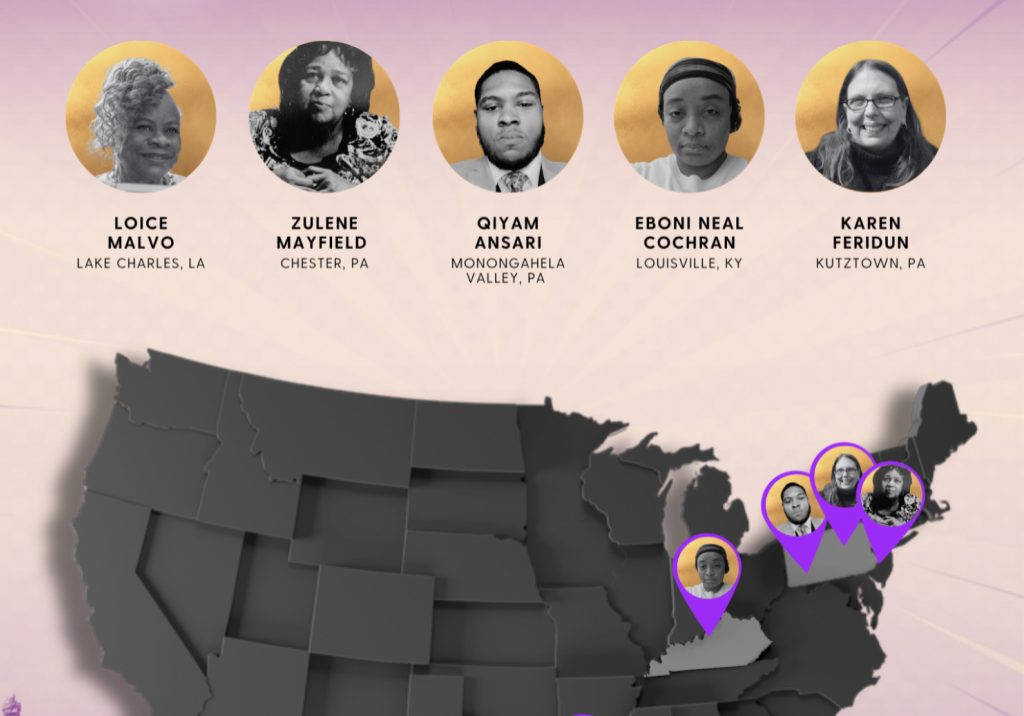
- Zulene Mayfield has spent decades organizing residents in Chester, Pennsylvania, to confront industrial pollution and environmental injustice through Chester Residents Concerned for Quality Living.
- Eboni Neal Cochran works with residents near Louisville, Kentucky’s Rubbertown industrial facilities, educating communities and advocating for stronger protections from toxic pollution.
- Qiyam Ansari works with residents of Pennsylvania’s Mon Valley to hold industrial polluters accountable and advocate for clean air through Valley Clean Air Now.
- Karen Feridun has helped build Pennsylvania coalitions opposing fracking and advancing climate action, including the Better Path Coalition and No False Climate Solutions PA.
- Lois Malvo has spent decades organizing neighbors in Lake Charles, Louisiana, to confront environmental threats and advocate for the health and safety of their communities.
Their stories remind us that environmental advocacy is sustained by people willing to take responsibility for problems that are often much larger than any one individual or community can solve.
Why recognition matters to a network
At Netcentric Campaigns, we spend a great deal of time thinking about what makes advocacy networks strong. We look at how people develop trust, share knowledge, find resources, build leadership, and coordinate their work across communities and organizations.
Recognition is an important part of that infrastructure.
In a large, distributed network, much of the most valuable work happens outside the spotlight. The people who connect neighbors, mentor new leaders, translate complex information, and hold groups together through difficult campaigns are often deeply respected locally but largely unknown elsewhere.
When a network takes time to recognize those contributions, it helps make that leadership visible to others.
It also communicates something about what the community values. The people we choose to honor become shared reference points. Their stories demonstrate the importance of persistence, generosity, courage, and the willingness to help others succeed.
Over time, those stories become part of the network’s common memory. New participants learn whose shoulders they stand on, where experience lives, and what meaningful contributions can look like.
The Sentinel Awards put these ideas into practice, showing how recognition can become an intentional part of how a network operates. We explored that broader role in our earlier article, Recognition Is Infrastructure.
This also connects to our emerging Networked Nation work, which examines how civic pollution weakens the relationships, trust, and shared spaces that allow people to work together. Practices like the Sentinel Awards help strengthen that civic infrastructure from within. By recognizing people who contribute to the common good, networks reinforce the relationships and shared values that make communities more resilient, even when they face disagreement, division, and outside pressures.
A moment to see the larger movement
There is another reason these gatherings matter so much to Halt the Harm Network.
Environmental advocates spend most of their time responding to urgent problems close to home. A community in Pennsylvania may be fighting a proposed gas facility while organizers in Louisiana are confronting industrial air pollution. Others are working on pipelines, fracking, waste facilities, or the health consequences of decades of industrial development.
Their circumstances differ, and so do their strategies. They may never work on the same campaign or belong to the same organization.
But they have a great deal to learn from one another.
One of the central purposes of Halt the Harm Network is to help those connections happen. The network makes it easier for people working in different places to find expertise, exchange information, share resources, and strengthen one another’s efforts.
The Sentinel Awards serve that same purpose in a different way.
For an evening, people can step outside their immediate campaigns and see the larger community of which they are a part. They encounter leaders from other places, recognize experiences that resemble their own, and celebrate accomplishments that might otherwise remain local stories.
There is value in simply being together for something other than the next crisis.
People who spend much of their time confronting harm also need opportunities to recognize progress, express gratitude, renew relationships, and celebrate the people who make this work possible.
Those moments help sustain a movement over the long term.
Join us in celebrating the 2026 Community Sentinels
The Community Sentinel Awards are a chance to give some well-deserved attention to people who have devoted years of their lives to protecting their neighbors and communities.
They are also an opportunity for the wider environmental justice community to come together around something worth celebrating.
We hope you will join us on Thursday, November 12, at 5 p.m. Central, online or in person in New Orleans, to hear the stories of this year’s honorees and help recognize their extraordinary contributions. Register to join online or in person; the New Orleans location will be shared after you register.
The work these leaders do matters enormously, even when it happens outside public view. Taking an evening to recognize them is one way we can show that their dedication has been seen, that their contributions are valued, and that they are part of a much larger community standing alongside them.
Learn more about the 2026 Community Sentinel Awards and register to attend.