
Seeing Around Corners: What Network Managers Learn to Notice at the Edges
After you spend enough time inside an issue, you develop a feel for who usually shows up around it.
In our work around data centers, we have sat through webinars, coalition calls, public meetings, comment periods, and plenty of conversations with people approaching the issue from different directions. There are environmental advocates, nearby residents, utility experts, organizers, and people concerned about water, electricity, land use, AI, surveillance, or local economic development.
After a while, you know the landscape.
So it caught our attention when firefighters started showing up.
Not everywhere. In fact, we had only seen it a couple of times. But that was exactly why it was interesting. Firefighters were not part of the usual configuration of this issue, and their presence suggested that something might be developing at the edge of the conversation that the rest of us had not fully understood.
The question became: Why are they here?
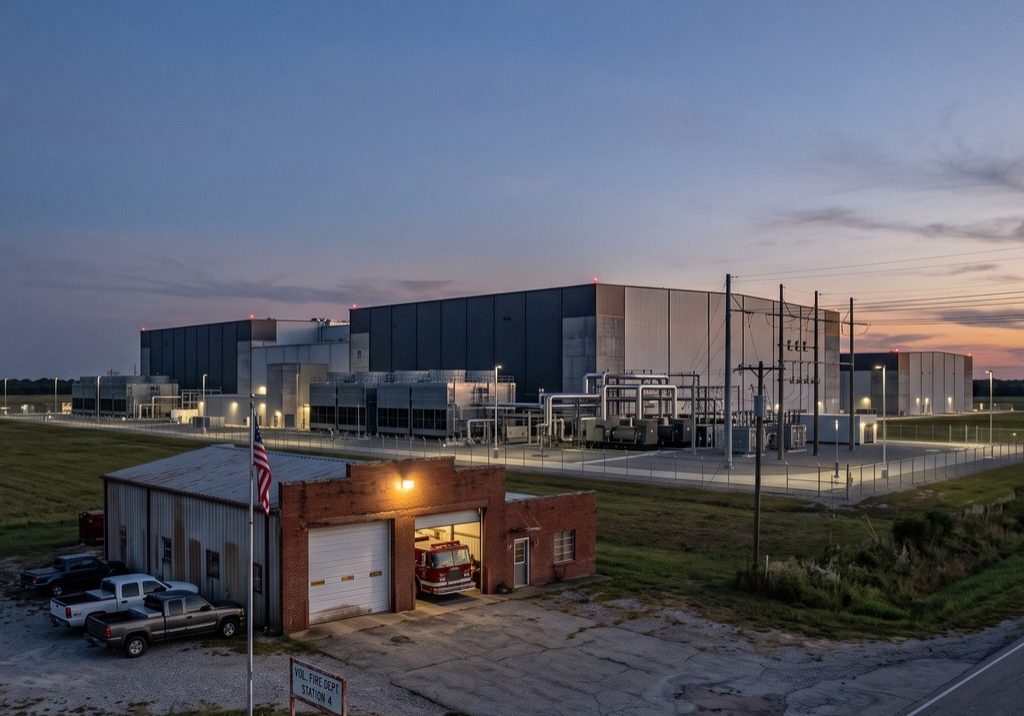
The answer points to a part of the data center debate that can easily get lost in the larger arguments about AI, electricity, and water. These are enormous facilities filled with electrical equipment, batteries, backup power systems, diesel generators, and other infrastructure that raises very practical questions about fire protection and emergency response. For a rural or volunteer fire department, a large new facility can introduce risks and response demands that look very different from what the department was built and trained to handle.
That makes firefighters important in two ways. They may be an affected constituency that needs resources, expertise, and connections of its own. But they also bring a very human dimension to an issue that can otherwise become abstract. Water consumption and grid capacity matter, but so does whether the people expected to respond when something goes wrong have what they need to do the job safely.
 Once that signal appears, a network manager has a choice. Treat it as an isolated appearance, or push on it a little and see whether there is something larger there.
When you manage networks, those are the things you learn to notice.
We tend to describe networks in terms of connection. They move information, relationships, resources, experience, and opportunities from one part of a field to another. That is all true, but there is another benefit that gets less attention.
A good network expands what you can see.
When enough people are looking at a problem from different communities, professions, institutions, and lived experiences, the network starts to function as a distributed sensing system. You begin to notice weak signals, gaps in the way an issue has been framed, and people or problems that do not fit comfortably into the categories everyone is already using.
We think of that as seeing around corners.
Pay attention to what does not fit
A lot of network work is fairly straightforward.
If one community is fighting a fracking development and another community two states away is dealing with almost the same thing, connect them. They can compare strategies, share research, recognize tactics they have seen before, and avoid solving the same problem twice.
That is useful work, and networks should do a lot of it.
But some of the more interesting value comes from asking about the things that do not fit quite so neatly.
Who keeps appearing at the edge of the issue?
What concern is surfacing that does not match the categories we started with?
Who is missing from a conversation where their absence suddenly seems important?
What are people in different places starting to notice independently before anyone has really put a name to it?
The firefighters in the data center work raised those kinds of questions. Are other firefighters seeing the same problem? What are they worried about? Do they need to know one another? Is there expertise elsewhere in the network that could help them prepare? Could fire and emergency response become another way for communities to understand what these facilities mean locally?
At that point, the outlier is no longer just something unusual. It may be showing you how the issue itself is changing, and where the network needs to grow next.
We saw this happen in WASH
We have watched a similar process unfold through Netcentric Campaigns’ work on water, sanitation, and hygiene in Ghana.
When people think about improving water service, they understandably think about technical capacity. Engineers matter. Mechanics matter. Utility operations matter. Infrastructure matters.
But as we worked with local governments and service providers through WASHDesk, something else kept coming up.
Customer service was getting much less attention than it deserved.
That observation became one of the distinctive contributions Netcentric Campaigns brought to the work. We began treating customer service not as a nice addition to water infrastructure, but as part of the infrastructure required to make service delivery work.
People need ways to report problems, ask questions, understand disruptions, provide feedback, and get a response. Service providers need to understand what customers are experiencing and where systems are breaking down. Trust, communication, and responsiveness affect whether people engage with the system at all.
So we built those ideas into the WASHDesk approach.
This was not something we arrived at after reading an academic review. It came out of working across the network and watching where service delivery repeatedly became weak. The technical side of the system was receiving enormous attention. The relationship between the provider and the people being served was not.
That was the signal.
Years later, we encouraged Aquaya, one of our research partners, to examine the academic literature and see what the evidence actually said about customer service and engagement in water service delivery industry-wide.
What they found was revealing.
Aquaya screened 460 records and ultimately included 27 studies covering 16 countries. Their review found that customer service and engagement had received relatively little systematic attention compared with other dimensions of water service delivery. Most of the documented engagement efforts were initiated by donors or NGOs rather than by service providers themselves. The available research suggested relationships with trust, satisfaction, water access, revenue collection, and service quality, although the evidence was still too limited to make strong causal claims or say which approaches work best.
The research did not create the customer-service insight for us.
It confirmed the gap we had already been working against.
That is an important distinction, and it gets at what seeing around corners can look like in practice. The network exposed a weakness before the research base had really caught up to it. Netcentric Campaigns turned that observation into a working model. Then an independent research partner went looking more systematically and found that the issue really had been understudied.
Now that research can move back through the network, where service providers, governments, funders, and others can use it to ask better questions and improve practice.
That is the loop we are interested in.
The network notices something. People investigate it. New knowledge gets produced. Then that knowledge comes back into the network and changes what other people are able to see and do.
The edge is not always right
None of this means that every odd signal deserves a strategy.
Sometimes a firefighter at a hearing is just a firefighter at a hearing. Sometimes the strange problem one community is experiencing really is unique to that community.
There is no value in turning network management into a hunt for novelty.
The skill is knowing when something deserves another question.
That requires enough familiarity with the network to know what the normal pattern looks like in the first place. It requires relationships across different parts of the field, not just regular conversations with the same handful of organizations. It also requires some restraint. You notice something, follow it, compare it with what others are seeing, and see whether the signal holds up.
If it does, the work becomes more concrete.
Maybe you connect people who had no idea others were dealing with the same thing. Maybe you bring in expertise the network did not previously need. Maybe you commission research. Maybe you create a new resource. Maybe all you do at first is put several people in a room and listen.
The point is not simply to identify the outlier. The point is to determine whether it tells the network something useful, and then make sure that learning can travel.
A network is not stronger because one person somewhere inside it knows something important. It becomes stronger when that information can move.
Build for peripheral vision
So what does all of this mean for network design?
Seeing around corners is a genuine network capability, but it cannot rest on the instincts or attentiveness of any one person. It has to be supported by the network’s structure: by who is included, how information moves, what kinds of observations are invited, and whether emerging signals can be compared and tested before they are obvious to everyone.
That is where design comes in. Many networks are built first around the most visible parts of a field: the lead organizations, the established partners, the shared projects, the common resources. Those are sensible starting points, and they matter. But if that is all a network is built to hold, it can become very good at circulating familiar information while remaining much less effective at detecting change.
Peripheral vision comes from a different set of choices. It comes from relationships that extend beyond the usual institutions, from creating ways for people to surface what they are seeing before it has hardened into a formal position, and from making sure observations can move inward from the edges rather than only outward from the center. In practice, that may mean bringing in people who are not usually treated as central to the issue, creating regular opportunities for local actors to compare notes, or simply asking better questions about what feels new, out of place, or difficult to categorize.
It also means treating diversity as a practical requirement rather than a cosmetic one. If everyone in the network comes from the same kinds of organizations, reads the same material, attends the same conferences, and approaches the issue through the same professional lens, the network may be highly connected and still have a narrow field of vision. A broader network does not automatically produce better insight, but it does make it more likely that someone will notice a meaningful change before it becomes obvious to everyone else.
Just as important, a network needs some way to evaluate what it is hearing. Faint signals are useful only if they can be compared, investigated, and connected to other forms of knowledge. A good network does not treat every anomaly as a trend, but it does make it easier to tell when something emerging at the edge points to a real shift in the problem, the constituency, or the work that needs to happen next.
The point is not to build a network that predicts the future. It is to build one with feedback mechanisms strong enough to notice where activity is growing, what is changing, and what new or unusual signals may deserve more attention.
That information should shape the network itself. It can tell you who needs to be brought in, where new relationships or resources are needed, and which emerging issues deserve deeper investigation. It can also shape how the network communicates what it is learning, creating opportunities to carry those insights back out through newsletters, posts, research, and other channels so more people in the network can recognize and act on them.
Seeing around corners, then, is not a separate trick or talent. It is part of how a healthy network learns from itself and adjusts as the world around it changes.
What is your network seeing?
If you are managing a network, it is worth asking whether you have built enough range and enough feedback into the system to notice what is happening beyond the usual participants and familiar issues.
Are important signals reaching you from the edges? Do people have ways to surface what they are learning? When something unexpected appears, does your network have the relationships and processes to figure out whether it matters and act on what it finds?
These are the kinds of questions Netcentric Campaigns works through with network leaders and managers. If you are seeing these challenges in your own work, or trying to strengthen your network’s ability to learn, adapt, and recognize what is emerging, reach out to Netcentric Campaigns. We would be interested in hearing what you are seeing. We would be glad to hear what you are encountering and talk through what it might mean for how your network is built.